
What buyers are really paying for isn’t just profit—it’s certainty.
One of the biggest myths in business ownership is that if two businesses generate similar revenue and profit, they should be worth roughly the same amount.
In reality, that’s rarely the case.
We recently completed the sale of two businesses operating in the same industry. On paper, they looked remarkably similar.
-
Annual revenue of approximately $3.5 million
-
EBITDA of around $750,000
-
Similar market conditions
-
Similar customer offering
Yet one business sold for approximately $1.15 million, while the other achieved $2 million.
That’s a difference of $850,000 despite almost identical financial performance.
So what happened?
The answer lies in what sophisticated buyers actually value.
Buyers Don’t Buy History. They Buy Future Cash Flow.
Every buyer asks one simple question:
“How confident am I that this business will continue generating these profits after the current owner leaves?”
The more confidence they have, the higher the price they’re willing to pay.
The less certainty they have, the more they reduce their offer—or structure the deal to protect themselves.
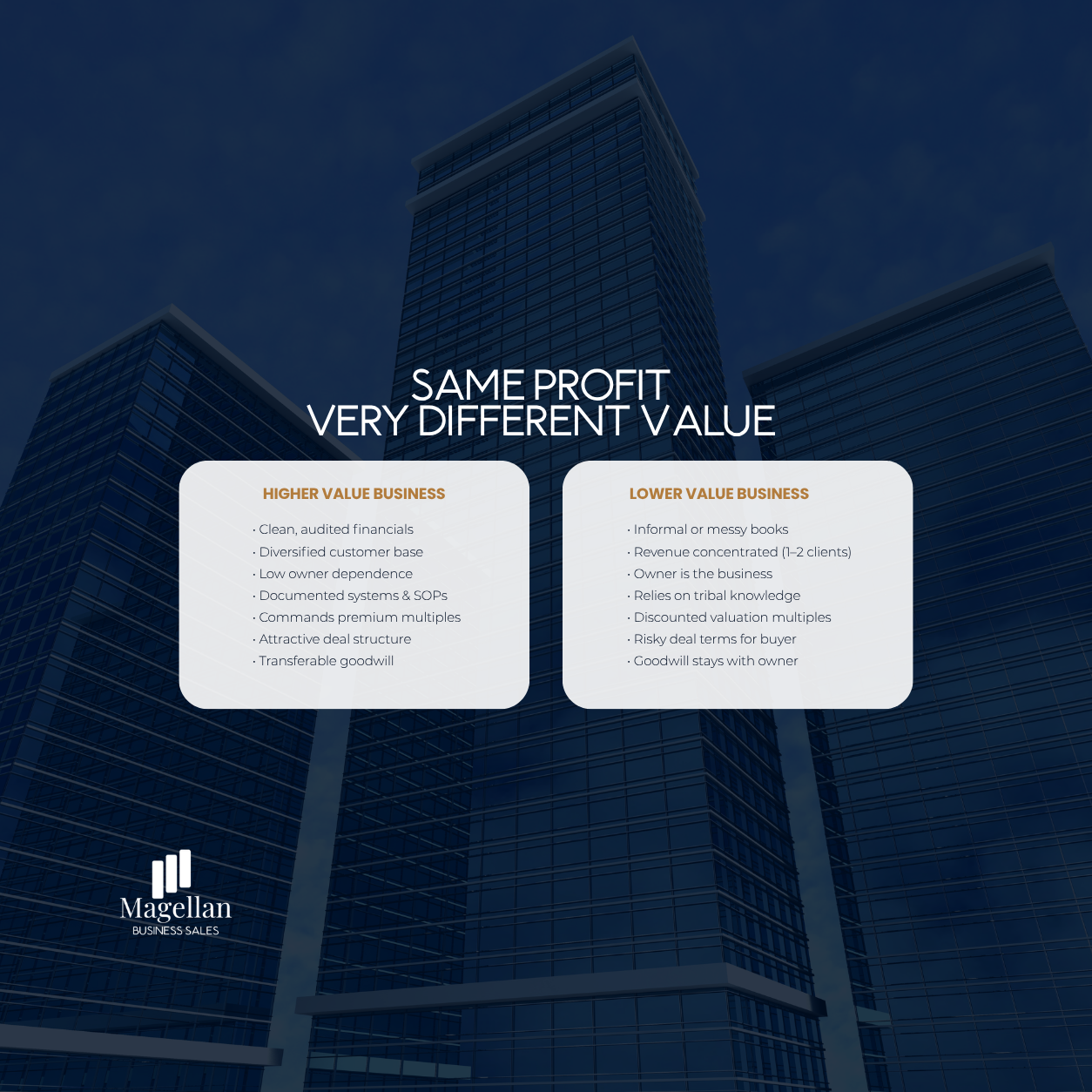
Here’s how these two businesses compared.
1. Quality of Financial Reporting
The higher-value business had clean, professionally prepared financial statements that clearly demonstrated its earnings.
The lower-value business required numerous adjustments and add-backs to calculate the true operating profit because personal expenses and owner benefits had been mixed into the accounts.
While add-backs are common in privately owned businesses, buyers naturally place greater confidence in businesses with transparent, well-documented financial reporting.
Lesson: Clean financial reporting builds buyer confidence and reduces negotiation.
2. Customer Concentration
This was perhaps the biggest difference.
The higher-value business had hundreds of customers, with no single customer representing more than 3% of annual revenue.
The lower-value business relied on one customer for approximately 50% of its turnover.
Imagine buying a business knowing that losing one customer could wipe out half your revenue overnight.
That’s not just concentration—it’s risk.
And buyers always discount risk.
Lesson: Diversified customers create premium valuations.
3. Owner Dependence
One owner spent only a few hours each week overseeing the business.
The management team handled the day-to-day operations, allowing the business to function independently.
The other owner worked more than 40 hours each week and was involved in virtually every decision, customer relationship and operational process.
From a buyer’s perspective, one business could continue operating tomorrow without the owner.
The other couldn’t.
Lesson: The less your business depends on you, the more valuable it becomes.
4. Systems and Documentation
The premium-priced business had documented operating procedures, clearly defined staff responsibilities and established processes that allowed the business to operate consistently.
The lower-priced business relied almost entirely on the owner’s knowledge.
Critical information existed only in the owner’s head.
That creates enormous transition risk for any buyer.
Lesson: Systems create transferable businesses.
5. Deal Structure Tells Its Own Story
Perhaps the clearest indication of buyer confidence was how each transaction was structured.
For the higher-value business:
-
Full purchase price paid at settlement
-
Owner provided a brief 30-day handover
-
Buyer was comfortable taking full ownership immediately
For the lower-value business:
-
Owner required to remain for 12 months
-
20% of the purchase price withheld as an earn-out
-
Payment depended on future performance and successful transition
The lower sale price wasn’t the only difference.
The seller also had to wait longer to receive all of their money and remained tied to the business for another year.
That’s a significant lifestyle cost many owners overlook.
The Real Drivers of Business Value
Revenue and profit are only part of the equation.
The businesses that achieve premium sale prices typically have strong performance across the fundamental drivers of value, including:
-
Reliable financial reporting
-
Diversified customer base
-
Low owner dependence
-
Documented systems and processes
-
Stable management teams
-
Predictable future earnings
-
Low operational risk
When these elements are in place, buyers compete harder, negotiate less aggressively and are prepared to pay higher multiples.
The Good News?
Every one of these value drivers can be improved.
That’s why business owners who begin preparing two or three years before selling almost always achieve better outcomes than those who wait until they’re ready to exit.
Increasing the value of your business isn’t about manipulating the numbers.
It’s about reducing risk.
Thinking About Selling in the Next Few Years?
Whether you’re planning to sell in twelve months or five years, understanding how buyers assess value today can make a substantial difference to your eventual outcome.
At Magellan Business Sales, we’ve advised on and sold hundreds of businesses across a wide range of industries. Through MBS Advisory, we also work with business owners years before they sell, helping them improve the key drivers that buyers value most.
If you’d like to understand what your business might be worth today—and, more importantly, what you could do to increase that value before going to market—we’d be happy to have a confidential conversation.
The best time to maximise the value of your business isn’t when you’re selling. It’s well before you decide to.